
Heart Pillow
A meditation on the loves we don't celebrate

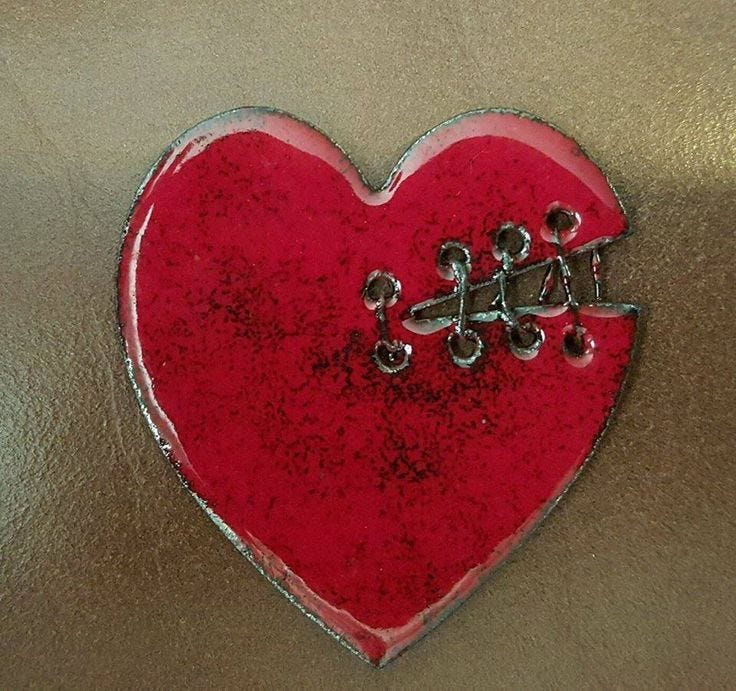
Wilson Ceramics smells like wet earth and old coffee, the way basements smell once they’ve stopped apologizing for being damp and old. The floor is permanently gritty. Every surface carries a fine white dust that resists erasure.
Just inside the door is a coat stand for jackets and handbags. Along one wall, shelves hold clay pieces in various stages of becoming—bowls, vases, lanterns glazed in soft yellows and pinks for the Chinese New Year. Below them, old Verka yogurt containers hold clay, their original labels half-faded away.
The opposite wall has sinks and aprons, potter’s wheels and low work tables scattered with tools—ribs, rulers, cookie cutters, stamps. On the walls hang a few finished things: a blue vase, a smiling sun, a set of wind chimes.
The tables are scarred with the evidence of earlier intentions—needle-tool scratches, faint rings from cups of water, the ghost outlines of projects that didn’t survive firing.
We are making heart pillows for Valentine’s Day.
Across the table from me sit Danica and Erica, nine and ten. They wear aprons that are too big and sneakers already dusted white. Danica is in pink; she works quickly, decisively, rolling her slab as if speed itself were a virtue. Erica wears an N-95 mask and moves more slowly, smoothing the same curve again and again, as if the clay might flinch. They are classmates, but they could not be more different.
“Mine is getting too chubby,” Danica says, pushing a curve inward with her thumb.
“That’s good,” Erica says. “Chubby is cozy.”
Their hands are small, their nails rimmed with clay. They talk to the material as if it can hear them, narrating their choices, scolding it gently when it resists. The instructor has explained the rules—score, slip, compress—but mostly we’re left alone to negotiate.
“Can I tell you about my dream last night?” Erica asks Danica.
“No,” Danica says.
“Please.”
“I dreamt that a unicorn came to school and took us all to space camp, which was on a spaceship. Then I took a bike from there and came back home.”
I look at Erica, surprised. She turns back to Danica and asks if she can tell another dream.
No.
I roll out my slab the way I’ve rolled chapatis all my life—palms flat, pressure even, a practiced turning that comes from repetition rather than instruction. The clay yields the way chapati dough does when it knows what’s expected of it. I press the cookie cutter down and trace the heart shape twice, noticing how careful I’m being. Adult-careful. Careful but also self-conscious in the way you are when you’re aware of being the only grown-up in a room of children.
The girls cut theirs quickly, confidently, needle tools dragging slightly at the curves, unconcerned with symmetry or consequence.
“Are you making yours for someone?” Danica asks, casual, already reaching for the scoring tool.
“I don’t know yet,” I say.
She accepts this immediately. Children have a higher tolerance for not-knowing.
We take our two hearts and start stamping them with little flowers and hearts. Mine has two hearts and the words “Unstoppable” and “You are the best.” Really?
The girls are more detail-oriented in their stamping and decoration. They write their names on their hearts and ask them why. They tell me it’s to make sure their parents know they made them.
Jocelyn, the instructor, comes by with a small bowl of marble-sized clay balls, each wrapped in paper so they won’t stick.
“You can put a few inside,” she says. “They’ll rattle after firing.”
The girls are delighted.
“A secret noise,” Danica says, dropping ten into her heart.
“A surprise,” Erica says, choosing just twelve. She holds each for a moment before letting it fall inside.
Danica wants to know what will happen to the balls when they’re fired.
“The paper burns away,” the instructor says. “That’s the point.”
I hesitate, then add a few to my heart. They land with a soft, muted click—barely audible now, but promised later. A sound encased in something temporary, waiting for heat to release it.
We close the opening carefully, score and slip again, smoothing the patch until it disappears. The heart is heavier now, its interior no longer needs protection but also air.
It is the third week of January.
My friends have been on my case since the first day of the year. You have to date. This is the year. Just one date. They talk about love the way people talk about exercise—unpleasant in the moment, essential in the long run. Their text messages and motivational TikToks arrive while I’m ordering prescriptions, while I’m scanning job postings, while I’m driving back from the nursing home with my hands still smelling faintly of sanitizer and lotion.
I am divorced. I have a 10-year-old poodle. I am looking for work. My mother lives in a nursing home now, which means my phone is never just my phone. It is a possible emergency and a reminder that time has its own schedule.
My daughter is in a stable six-year relationship. The kind that feels structured and stable, and one with a nice boy she met in school. When she talks about her life, it’s not drama but a five-year plan. She talks about groceries she just picked up to make blueberry muffins with cottage cheese. She plans trips for 2026 like Norway in April. She’s even planning her wedding in 2027 with a wedding planner. One part of the universe is behaving.
Sometimes I listen and feel proud. Sometimes I feel a faint, ungracious envy—not of romance exactly, but of ease. Of the way some lives seem to have solved the question of who witnesses them.
I hate that I feel this. She is my daughter. I should be purely, uncomplicatedly happy for her. And I am—or at least, most of me is. But there’s a sliver of something else, something I’m ashamed to name even to myself. It’s not that I want what she has. It’s that I want anything to feel that settled, that certain. I want one part of my life to stop requiring negotiation.
The guilt arrives immediately, like a reflex. What kind of mother envies her own child’s stability? What kind of person can’t just be glad that someone they love isn’t struggling?
But maybe it’s not envy of her. Maybe it’s grief for an earlier version of myself who also had answers, who also knew who would be there at the end of the day. Who didn’t have to perform confidence or ration hope or carry guilt like a purse.
My situation today is this: divorced, with an aging mother in care, a partnered daughter, an ongoing job search—and a poodle very much present.
My mother’s life now requires signing in at a desk and speaking to people who know her better than I do. I bring small offerings—soft socks, Starbucks lattes, Indian laddoos and curries she may or may not eat—as if I can barter with time.
The aides know her rhythms, her moods, which foods she’ll accept and which she’ll refuse. They know whether she slept, whether she asked for anything, whether she remembered to ask at all. I arrive with gifts and good intentions, and they update me with the kindness of people who do this work every day. They are patient with my questions. They do not say what we both know: that I am a visitor in my own mother’s life now.
The nursing home has its own light, its own smell, its own careful language of efficiency. Everything is designed for safety, for management, for the graceful containing of decline. I sit with her and we talk, or we don’t.
I tell myself I’m doing my best. That I visit regularly and call twice a day. That the nursing home is good, the staff is kind, that she’s safe and cared for. I stack these facts like evidence in my defense, though no one is prosecuting me except myself.
When I leave, I carry guilt the way I carry my purse: automatically. Guilt that I couldn’t keep her at home. Guilt that I feel relief when I walk out those doors.
The job search has its own rituals. Open laptop. Read. Edit. Apply. Wait. Pretend not to care. Check again. Confidence becomes something you perform rather than feel.
They mean well. They really do. They send articles about dating apps, about putting yourself out there, about how you miss all the shots you don’t take. They frame romance as self-care, as something I owe myself after the divorce. As if love were a spa day I’ve been denying myself out of stubbornness.
But they have jobs that are stable and well-paying. They have partners who split the mortgage, the utilities, and go to destination weddings in Thailand. They can afford to think about love as the primary project because survival isn’t taking up all the space in their heads.
When they say “just one date,” they don’t hear themselves asking me to spend money I don’t have—on an outfit, a dinner, a tank of gas to meet a stranger who will probably disappoint us both. They don’t see that I’m already performing for strangers every day: hiring managers who want enthusiasm, energy, proof that the gap in my resume is an adventure rather than a failure.
I don’t say any of this. I say, “Maybe,” or “We’ll see,” or “You’re probably right.” I let them believe I’m being difficult, being scared, being too picky. It’s easier than explaining that Maslow’s hierarchy is real and I’m still working on the bottom tiers.
When they say “This is your year to date,” I think about health insurance. About the gap in my resume that grows wider with each passing week. About how “pursuing my passion” is a luxury reserved for people with safety nets I no longer have.
My friends talk about love as if there’s only one kind that counts. The romantic kind. But I am already managing love—just not the kind they recognize.
I love my daughter by staying out of her way, by not making my loneliness her problem. I love my mother by showing up with ladoos she won’t remember eating. I love Snowy by keeping her routine steady even when mine has fallen apart.
These loves require work. They show up on my calendar, in my bank account, in the way I organize my days. But they don’t come with Valentine’s Day cards or someone to split the mortgage with.
The stores are already full of hearts. In a few weeks, my friends will post pictures of their dates, their proof of being chosen. I will have a ceramic heart I made for myself, waiting to be picked up from a studio that smells like wet earth.
On the drive back home, I think about the heart drying on a shelf across town. How it now contains something unseen. How it will make noise only if moved. How the sound depends on heat, on pressure, on survival.
Valentine’s Day will arrive whether I am ready or not. I may date or I may not. I don’t need to decide everything at once.
But I did make a pink heart embellished with curvy green lines and little stamps of affirmation—one of them “You are the best,” the other “Unstoppable.” I’m not entirely sure if either is true, but those were the only stamps in the studio that called to me. I learned how to join two halves and leave room for movement.
The heart pillow sits in the kiln now, getting fired. I’ll pick it up before Valentine’s Day—a creative gift to myself I stamped and sealed and made whole myself.
At home, Snowy greets me as if I’ve returned from a long journey, even if I’ve only been gone a couple of hours. She presses himself against my ankle, warm and insistent. Sometimes I wonder, not tragically but practically, if she is the only love I have left to manage.
The night continues. On a shelf across town, hidden rattles wait for heat to give them voice.
Thanks, really touching essay. Unapolagetically human. We all have thougths and struggles that are uncomfortable to share, and the fact you can do so with such eloquence is truly impressive.
We all struggle with striking balance, between commitments, responsibilities, guilt and our human condition. This essay captures all of it, in such a masterful way and resonates with people that really care.
I've had conversations over the years with my mom about her aging parents and this felt so familiar.
Thank you writing this.