
Neither here nor there

When my father died in an air crash, my mother, brother and I moved in with my grandparents, into a house with a garden on a treer-lined street in Bangalore..
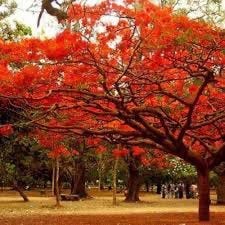
Gulmohar trees arched overhead on our street, their flame-orange blossoms so thick in May they filtered the light into something amber and dreamlike. Our neighborhood was mostly houses then, families who knew each other, vegetable vendors lining up outside on the street each morning with their pyramids of tomatoes, greens and okra bargaining with frugal customers, while the milkman milked his cow right in front of our home.
When I left Bangalore in 2000, it was a city of roughly five and a half million people. That version stayed frozen inside me - sleepy, green, manageable. A place that valued slowness in pockets, where ambition existed but hadn’t yet swallowed everything else. In my mind, it remained that way.
The orange gulmohars kept blooming. The streets kept their lazy rhythm. The koels kept singing and the vendors continued selling vegetables. Time moved forward everywhere except in my memory
Sometimes I think immigration works like a wormhole. You don’t arrive in the present tense of a country; you arrive in the year it admits you.
The version of the country you first encounter becomes your baseline. It shapes your internal map about what feels normal, what feels possible, what feels threatening, what feels generous. Even as the country evolves, that first imprint lingers
Each immigration wave steps into a different America and carries that timestamp forward, quietly intact. We share the same geography, but we’re calibrated to different eras, speaking slightly different dialects of the same dream.
We are not just from somewhere else but also from some other time, and continue to exist in the year we entered, even as the calendar moves on.
Last year, I went back to Bangalore in May.
I forgot how to cross the road.
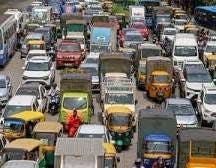
Not metaphorically, but literally. I stood on the corner near my mother’s house—one of the few houses left on the main road. I was watching the traffic blur past in a city of fifteen million. The gulmohars were gone. Cut down. In their place: electrical wires, harsh white sky, unfiltered sun beating down on concrete.
The rest of the road had been overtaken by stores: hospitals, pharmacies and labs on one side, clothing and gold shops on the other.
Bangalore consistently ranks among the most congested cities in the world; the average driver here loses more than 250 hours a year to traffic. But congestion isn’t the right word for what happens at street level. This isn’t gridlock; it’s choreography.
When you cross a road in Bangalore, it’s important to read the gaps, trust your timing, and move forward, sometimes even run, knowing that hesitation is often more dangerous than movement. There are no clear rules, only a shared understanding that everyone is improvising together. Cars slow without stopping. Autorickshaws squeeze through spaces that seem imaginary. Pedestrians insert themselves into this flow not by asserting right of way, but by becoming legible by signaling intent, moving decisively enough to be seen.
The rhythm, the timing, the specific brand of calculated risk that Bangalore traffic demands had left my body.
I’d been in California too long.
And maybe that’s why I don’t fit into today’s India. The India I returned to runs on hustle and money. People talk about their real estate properties and vacations to Azerbaijan and Italy. I don’t know the new signals and stick out like a sore thumb. I don’t dress quite right for it(I never know what’s in fashion in India), and hesitate where others assert. The risk tolerance I learned no longer matches the tempo of the street.
So I miss my timing in both places. In America, I arrived too early or too late, never exactly now.
In India, the country moved forward without waiting for my body to catch up.
I hesitate at four-way stops in California. It’s not because I don’t know the rules.Whoever arrives first goes first. Simple. Logical. Nothing like Bangalore’s negotiated chaos. And yet I still pause, uncertain, watching the other drivers for some signal I can’t quite read. The hesitation is brief enough that no one honks, but long enough that I feel the fractional delay between knowing what to do and trusting I have the right to do it.
In Bangalore, I lost the choreography of improvisation. Here, I never fully learned the confidence of following rules.
At parties, when conversation turns to childhood TV shows or high school football, I smile and nod, present but not quite there. I watched reruns of Friends and Star Trek on Star World in Bangalore, years after they aired here, while my California friends were at Imagine Dragons concerts I’d never heard of.
We’re talking about the same decade, but we’re not talking about the same time.
Last year, when I was in Bangalore for work, none of my friends wanted to visit me for dinner. I was staying at a five star hotel, The Oberoi on MG Road, a location that once meant something, that used to be the center of everything and where we met regularly in college. Friends hesitated and said it was too far and too much trouble.
What leaving does is not give you two homes. You don’t fully belong on either side anymore. The road doesn’t become easier to cross and you learn that standing in the middle is not failure.
For me, Lalbagh Botanical Gardens has always existed outside the question entirely. Growing up, it was my escape and a place where the city loosened its grip and let me wander without urgency.
The paths were wide enough to think on, the trees old enough to outlast whatever phase the city was in.
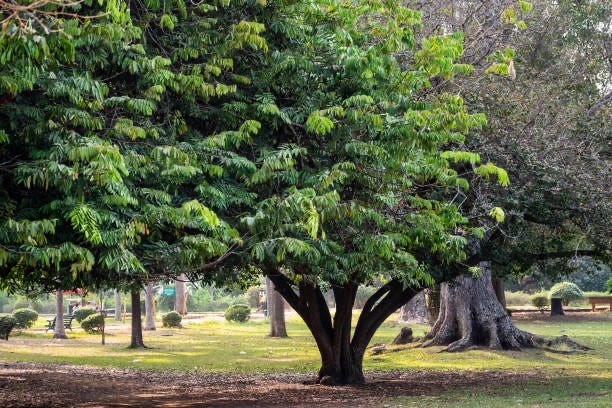
Lalbagh appeals to me because it operates on a different timeline than the rest of Bangalore. While the city cuts down gulmohars for wider roads and accelerates into its tech-driven future, Lalbagh still has its 300-year-old White Silk Cotton tree and the 270-year-old mango tree that Hyder Ali planted in 1760. There are century-old rain trees, massive baobabs from Africa, towering araucarias, the brilliant red blooms of Bombax ceiba, and the fragrant champaca trees. The rock at its center is three billion years old. These aren’t decorative but ancient and operating on geological time while Bangalore reinvents itself every decade.
I can walk there without negotiating my right to enter, without timing gaps in traffic or reading social signals. The trees don’t care which version of Bangalore I’m calibrated to, don’t ask me to keep pace or prove I belong. They simply continue, patient and indifferent, letting me exist alongside them without requiring anything in return.
Even now, when Bangalore feels unrecognizable, Lalbagh remains legible. The same lake inside the park holds the sky. The same tall trees stand, uninterested in growth curves or traffic flows.
Maybe that’s what I’ve been looking for all along. It is not the ability to cross the road in Bangalore or the confidence to proceed at four-way stops in California, but the knowledge that belonging doesn’t always require permission. That there are places, and parts of myself, that exist outside the choreography entirely.
The road is about timing and risk and negotiating your right to enter. Lalbagh is about none of those things. It simply remains, indifferent to whether I’ve mastered the city’s new rhythm or forgotten its old one.
I still can’t cross that road but I’ve learned that standing in the middle isn’t about being stranded between two places. It’s about recognizing that maybe I don’t need to cross at all.
Some forms of home don’t require you to fight your way in. They’re just there, waiting, asking nothing.
Such a beautiful reflection, Shobhana. Those orange blooming trees, too, gorgeous. They grow in S Florida as well and were always one of my favorites.
I love the way you talk about timestamped baselines, it makes so much sense. Even in my hometown where I was born and raised (and moved away from), when I go back now I feel displaced because I didn't witness the changes, wasn't part of them (I think).
Your line that "belonging doesn’t always require permission" is striking. I think sometimes it's our choice to allow ourselves to belong, and in the case of the botanical garden, I like the notion that it exists almost as a parallel universe in which the trees don't need, want, or ask for anything from you.
This is really beautiful, Shobhana. I really related to it, even though I never lived in India, I still have it preserved in my memory from the last time I was there and know it's changed a lot. I loved how you weaved the memories between both places and captured how it feels to be a part of two cultures and feel like you are an outsider in both. Great essay!